
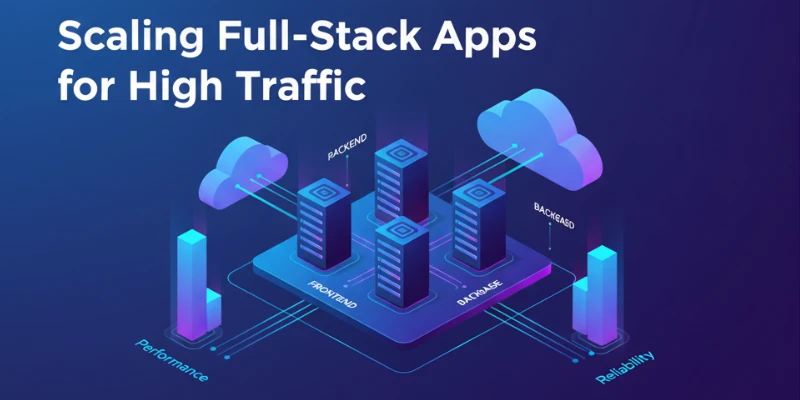
As your web application grows, so does the number of users accessing it at the same time. Handling high traffic is not only about keeping your site online but also about maintaining speed, reliability, and user satisfaction. Scaling a full-stack application effectively means optimizing every layer, including frontend, backend, and database, to work together smoothly under heavy load. To learn these techniques in depth, a Full Stack Developer Course in Trivandrum at FITA Academy provides hands-on training and expert guidance for building high-performance applications.
Understanding Scalability
Scalability describes an application’s ability to handle an increasing number of users without compromising performance standards. A scalable system can adjust resources as demand rises or falls. The goal is to maintain consistent response times even during peak usage. Scalability can be achieved by improving both the infrastructure and the application’s internal design.
Frontend Optimization
A fast and efficient frontend reduces the load on your backend. Using caching techniques, such as storing static assets on a Content Delivery Network (CDN), helps deliver files quickly to users regardless of their location. Minimizing image sizes, lazy loading content, and optimizing JavaScript execution also make the application more responsive. These steps not only improve the user experience but also decrease the number of server requests. To master these techniques and become a skilled full-stack developer, enroll in the Full Stack Developer Course in Kochi.
Backend Efficiency
The backend is essential for handling requests and delivering data. One highly effective approach is load balancing, which spreads incoming traffic over several servers. This prevents any single server from becoming overloaded. Implementing caching at the server level reduces the need to repeatedly fetch the same data from the database. Additionally, asynchronous processing allows your backend to handle multiple tasks simultaneously, which boosts performance during high-traffic periods.
Database Scaling
Databases are often the bottleneck in a growing application. Horizontal scaling, which involves adding more database servers, helps manage large volumes of data and queries. Vertical scaling focuses on upgrading the existing server’s resources such as CPU and memory. Using indexing, query optimization, and database replication ensures faster data retrieval and better reliability.
For read-heavy applications, read replicas can handle queries separately, reducing strain on the primary database. To gain hands-on experience with these techniques and more, enrolling in a Full Stack Developer Course in Delhi can provide practical training and expert guidance.
Caching and Content Delivery
Caching is a key technique for scaling full-stack applications. Keeping commonly used data in memory or distributed cache systems allows your application to react more quickly to user inquiries. A Content Delivery Network further enhances speed by serving cached assets from locations closest to the users. Together, these methods reduce database load and shorten response times.
Monitoring and Auto-Scaling
Ongoing observation is crucial for detecting performance problems at an early stage. Tools that track server metrics, database usage, and response times can help developers make data-driven decisions. Setting up auto-scaling ensures that additional resources are automatically added when traffic spikes and released when demand decreases. This approach saves costs while maintaining consistent performance.
Scaling a full-stack application for high traffic is an ongoing process that requires attention to every component of your system. From frontend optimization and backend load balancing to database scaling and caching, each step contributes to building a resilient application.
By implementing effective planning, oversight, and automation, your application can manage thousands or even millions of users without experiencing delays or failures. For those looking to master these skills, a Full Stack Developer Course in Jaipur provides practical training and professional support to create scalable, high-performance applications.
Also check: How the Web Works A Simple Explanation